Report Cover, Clinical Trial Software Industry, Blue, market size charts.

Clinical Trial Software Market Size

Clinical Trial Software Market Size to 2034. An Overview of Market Size, Growth and Vendor Landscape

Key Takeaways – TL;DR:

This market is large, diversified across many modules, and growing steadily through 2034.

  • The Clinical Trial Software Market Size for 2026 is estimated at $13–14B USD and the average almost doubles ~$22.46B by 2030 and almost triples ~$37.10B by 2034.
  • Most research keep a low-teens CAGR of 10-14%
  • North America is the largest region today. APAC is the fastest growing from a smaller base.
  • Patient data integration, protocol complexity, cloud delivery, decentralized and hybrid trial models, evolving compliance requirements and embedded AI features are the main demand drivers.
  • betterclinical’s market landscape and directory shows 400+ software solutions
  • EDC, CTMS, and eCOA/ePRO remain dominant categories, while DCT platforms, RTSM, and analytics lead the growth curve.

Table of Contents

Clinical Trial Software Market Size Overview

The global clinical trial software market has matured into one of the most important components of life sciences technology. These platforms manage the planning of studies, capture and clean data, manage sites and patients, handle consent and safety, control trial documents, randomize and supply treatments, and track the work from first visit to database lock.

The growth story is clear. As trials become more complex and geographically distributed, the need for reliable, compliant, and connected digital tools keeps expanding.

Multiple Research Reports

To help present a robust view of the Clinical Trial Software Market size, we have collated data from multiple reputable sources to present a forecast through 2034. Each of these sources has utilized their own methodologies and datasets to represent clinical trial software market size conditions. We aim to present readers with an aggregated overview of the Clinical Trial Software Market’s size, growth rate and give an understanding of the market’s evolution, key drivers, and potential challenges moving forward.

Market Size

The clinical trial software market size, also called the eClinical market, is broader than many expect. Current estimates show the market size to be around $13–14B USD and the average almost doubles ~$22.46B by 2030 and almost triples ~$37.10B by 2034.
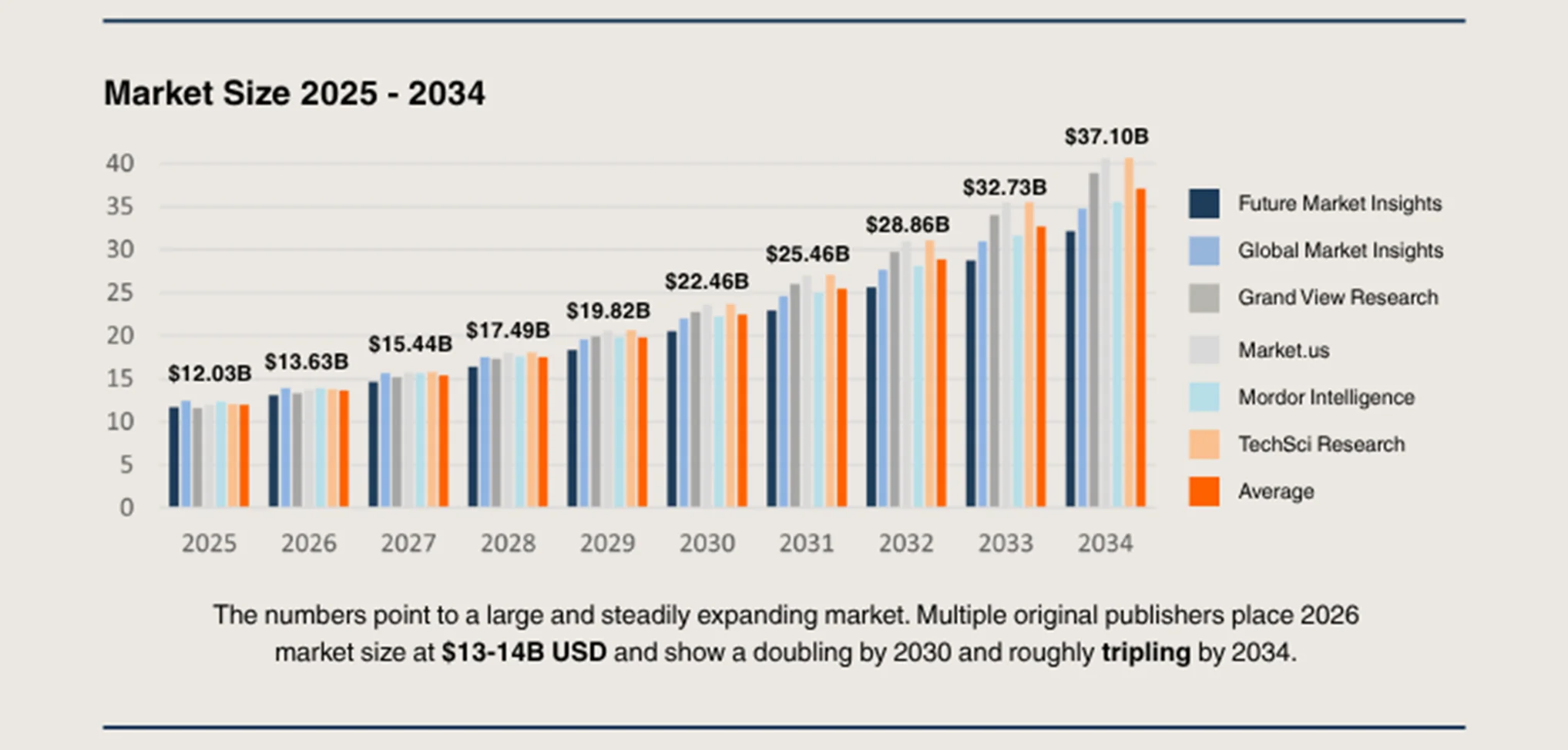
Clinical Trial Software Market Size chart, Clinical Trial Software Industry bar chart, bar chart growth


Marketing Growth to 2034 is strong.

Over the next decade, expect steady CAGR of 10-14% growth, a broader mix of categories in the average software stack, and more emphasis on integration, validation, and site usability. Success will come from platforms and add-ons that reduce manual effort, improve data integrity, and make decentralized work routine rather than hard.

Regional Outlook

North America remains the largest market today, while Asia Pacific is growing fastest as research footprints expand and local ecosystems mature. Growth is not limited to a few big vendors. The ecosystem includes hundreds of specialized products, which lets buyers assemble stacks that fit their study mix and operating model.

North America: 44-48% share. Dominates due to large sponsor base and advanced digital infrastructure.

Europe: 25-28% share. Driven by strict regulatory requirements and high adoption of validated systems.

APAC: 18-22% share. Fastest-growing region as multi-country trials and site digitization expand.

RoW: 6-8% share. Early adoption stage but increasing participation in global trials.

Clinical Trial Software Market Size Regional Outlook, Clinical Trial Software Industry chart by geography


Why the Clinical Trial Software Industry is growing

Sponsors and CROs are running more complex studies with more data sources, and they need software to keep quality high while timelines tighten. Decentralized and hybrid models are no longer experiments. They depend on reliable platforms for remote capture, scheduling, drug supply, and monitoring. Cloud delivery shortens setup and makes global collaboration easier. AI features are moving from pilots into day-to-day use for data quality checks, enrollment forecasting, and risk signals. These shifts raise the floor for software adoption and keep growth steady across the decade.

More trials, more data, more moving parts

Trial counts have climbed, and protocols now pull data from wearables, eSource, imaging, and real-world data. Spreadsheets and manual routing can not handle this load at scale. Teams standardize on eClinical platforms because they reduce errors, preserve audit trails, and keep sponsors and sites on the same page.

Decentralized and hybrid models need software to work

Remote visits, home health, and site-light designs depend on software for consent, patient reporting, randomization, drug supply, and risk monitoring. When organizations move beyond pilots to portfolio-level rollouts, they consolidate on unified platforms that reduce hand-offs and rework.

Cloud and AI are now standard features

Cloud delivery shortens implementation cycles and supports global collaboration. AI shows up in anomaly detection, enrollment forecasting, data quality checks, and document processing. These features remove time from database lock and improve data integrity.

Regulators expect digital controls

Audit trails, validation, and electronic submissions are baseline expectations in mature markets. That pushes teams toward proven platforms with strong compliance features and steady release management. It also favors vendors that can document controls clearly.

Category mix is widening

 Spending is expanding beyond EDC and CTMS into eTMF, eConsent, RTSM, integrations, and analytics. That supports growth even if one module’s budget is flat in a given year.

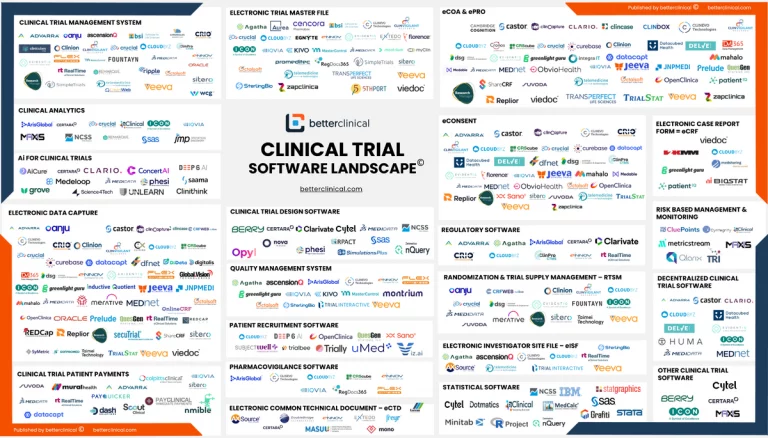
Clinical Trial Software Market Size InfoGraphic

The following infographic summarizes findings and the industry into an easy to read format. It is also available as a PDF download below.

Summary of Research Reports on Clinical Trial Software Market Size

We have published some the information on the clinical trial software marketing size as presented in the research reports we collected. Each research report utilizes its own methodologies to determine their research findings. The data and content shown below is summarized from each research report. Each source report is cited along with links to their report.

All values are global, USD billions. “2034 projection” extends each source’s stated CAGR beyond its published horizon where needed. Marked clearly as a projection

Market.us and GMI publish rates to 2034, so the projection aligns with their stated horizon. FMI runs to 2035, so the 2034 figure sits just below its 2035 endpoint. TechSci publishes to 2030; extending its rate produces a similar 2034 range to Market.us.

Mordor Intelligence

Mordor describes eClinical as the complete software toolkit that runs a study from planning to closeout. That includes EDC or CDMS, CTMS, eTMF, eCOA or ePRO, RTSM or IRT, safety, and analytics. The report explains how growing protocol complexity, larger data volumes, and the push for decentralized and hybrid studies have turned these systems from optional add-ons into core infrastructure for sponsors and CROs.

North America is identified as the largest market today, while Asia Pacific is gaining ground as research capacity and local vendor ecosystems develop.
Cloud delivery is highlighted as a major reason adoption keeps rising. The write-up points to quicker deployment, easier scaling across studies and regions, and better access for distributed teams compared with on-premise setups. Integration also gets attention. buyers want platforms that connect data capture, operations, and documents without constant manual handling. That integration need is pushing the market toward suites or tightly connected stacks rather than a patchwork of point tools.

Key points

  • 2026 size: $13.93B
  • CAGR window: 12.42%
  • 2030 projection: $22.25B
  • 2034 projections: $35.54B
  • Growing use of cloud delivery and unified platforms
  • Wider adoption of decentralized and hybrid trial models
  • Ongoing shift from point tools to integrated stacks


Grand View Research

Grand View Research treats eClinical as a broad software category that spans data capture, study operations, document control, patient reporting, randomization and supply, and related oversight. The report links market expansion to sustained R&D spending, higher expectations for data integrity, and wider use of patient-centric workflows. North America accounts for the largest share in their regional view, with Asia Pacific accelerating from a smaller base as digital practices spread and local sponsors expand pipelines.

Cloud-based delivery is a recurring theme. The analysis notes that sponsors prefer web-delivered systems because they shorten implementation, simplify multi-country rollouts, and reduce the internal maintenance burden. It also notes a clear shift toward integrated platforms that reduce hand-offs and give clinical, data management, safety, and QA teams a shared view of study status. Usability and real-time dashboards get specific callouts as reasons buyers consolidate around fewer vendors.

Key points

  • 2026 size:$13.28B
  • CAGR window: 14.39%
  • 2030 projections: $22.74B
  • 2034 projections: $38.93B
  • Integrated platforms reduce hand-offs and speed cycle times.
  • North America leads now, APAC is accelerating.
  • Cloud adoption is a major lever for global teams.


Future Market Insights

FMI focuses on software across the standard eClinical stack and ties demand to the practical problems teams face in decentralized and hybrid designs. The discussion centers on how coordinated systems improve data quality, speed issue detection, and support continuous monitoring without adding friction for sites. The report keeps the lens on software rather than services and repeats the industry pattern. North America leads today, while Asia Pacific grows quickly as research networks and regulatory familiarity expand.

The report emphasizes the move to cloud as a lasting change. Software delivered as a service makes it easier to keep validation in step with frequent releases, to manage access for global teams, and to absorb new data sources like wearable feeds or home health visits. FMI also notes that AI features are moving from pilots into everyday workflows. examples include anomaly checks, coding suggestions, and document processing that reduce the load on data managers and study teams.

Key points

  • 2026 size:$13.08B
  • CAGR window: 11.9%
  • 2030 projections: $20.50B
  • 2034 projections: $32.15B
  • Decentralized trial adoption continues to expand.
  • AI features are moving from pilots into everyday workflows.
  • Longer horizon suggests growth remains steady rather than spiky.

Market.us. 

Market.us presents eClinical as an end-to-end software layer that connects patient and site touchpoints to data pipelines and operational oversight. The report describes a market where large buyers standardize on platforms for reliability and audit readiness, then extend those platforms with targeted add-ons where a specialist tool makes work easier. Regional commentary places North America at the top by share, with Asia Pacific expanding as sponsors spread study footprints and local vendors mature.

Cloud delivery is framed as the default for modern deployments. The analysis points to faster set-up for new studies, simpler version control across a portfolio, and better collaboration with CRO partners and sites. It also flags growing interest in analytics that sit on top of operational systems, giving teams forecasting and quality signals. This stack pattern, a platform plus analytics plus selected add-ons, is presented as the common operating model for the next few years.

Key points

  • 2026 size:$13.74B
  • CAGR window: 14.5%
  • 2030 projections: $23.62B
  • 2034 projections: $40.59B
  • Double-digit growth persists across a long horizon.
  • AI and analytics are baked into platform roadmaps.
  • North America’s share remains high, with APAC rising quickly.

TechSci Research

TechSci describes a market shaped by dense protocols and real-time coordination across sponsors, CROs, and sites. The report positions eClinical systems as the practical fix for bottlenecks in data capture, study tracking, consent, and safety management. It stresses that buyers look for reliable audit trails and clear role controls, then evaluate vendors on integration depth and the ability to support mid-study changes without long delays. North America is cited as the largest market, while Asia Pacific grows faster from a smaller base.

Cloud appears throughout the discussion as a reason switching costs are falling. Web-based systems let teams roll out new modules faster, support distributed study teams, and streamline patching and upgrades. TechSci also points to the gradual replacement of narrow point tools with platform modules or closely integrated partners, because that reduces validation burdens and duplicate data entry. The result is a steadier operating rhythm across multiple concurrent studies.

Key points

  • 2026 size:$13.79B
  • CAGR window: 14.47%
  • 2030 projections: $23.72B
  • 2034 projections: $40.66B
  • Complexity and real-time coordination are the main pain points.
  • Cloud delivery reduces rollout time and maintenance overhead.
  • Unified platforms are displacing one-off point tools.

Global Market Insights

GMI centers its narrative on decentralized and patient-centric trial models that depend on software for remote capture, scheduling, drug supply logistics, and continuous oversight. The scope is the usual full stack. EDC, CTMS, eTMF, eCOA or ePRO, RTSM or IRT, eConsent, safety, integrations, and analytics. The report discusses how integrated platforms help reduce the cost and risk of stitching systems together and give sponsors a consistent evidence trail across the study lifecycle. Regionally, it maintains the same picture as peers. a stable lead for North America with quickening adoption in Asia Pacific.

Cloud-based delivery is presented as a structural advantage. GMI notes that hosted platforms make it simpler to support many sites with different levels of digital maturity, to add new countries, and to keep environments aligned for audits. It also highlights the importance of interoperability and standardized data flows so teams can combine patient-reported outcomes, operational signals, and safety cases without constant manual work. This interoperability push is described as a key reason integrated platforms continue to gain share.

Key points

  • 2026 size:$13.93B
  • CAGR window: 12.1%
  • 2030 projections: $22.00B
  • 2034 projections: $34.75B
  • Remote data capture is now routine rather than niche.
  • Patient-centric designs increase demand for eConsent and eCOA.
  • The shift to integrated platforms reduces integration debt.

The Clinical Trial Software Landscape – Larger than most realize

Many discussions, including research reports, focus on a handful of platform vendors. However, the real market is broader than most realize; as shown by betterclinical’s clincial trial software vendor landscape that maps over 400 software solutions across 20+ categories.

Roughly four in ten listings sit in data capture: EDC, eCOA or ePRO, and eConsent. The top five categories of EDC, eCOA/ePRO, eConsent, eTMF, CTMS account for ~54% of all listings. That concentration shows where software vendors have placed their focus; on optimizing data capture, patient input, and trial operations. 

No such things as best clinical trial software

There’s no single “best” clinical trial software because clinical research is too complex and specialized. The industry has a number of niche categories each solving distinct problems.

Success depends on choosing the right software for your specific needs: your organization’s size, trial phase, regulatory requirements, and integration capabilities. Focus on fit-for-purpose selection based on interoperability, compliance, user experience, scalability, and total cost of ownership, not popularity rankings.

The goal isn’t finding one perfect tool, but building an integrated ecosystem of software that work together for your unique workflow.

Clinical Trial Software Categories

To understand why “best” lists are misleading, you have to see the ecosystem as a whole. Clinical research software spans several interdependent categories, each with its own role in the life cycle of a study. Below is a sample of 20 categories of clinical trial software that defines this landscape. We link to each category’s page in the betterclinical vendor directory.

  1. Clinical Trial Management System (CTMS) – The operational hub that tracks study milestones, tasks, sites, budgets, and performance.
  2. Electronic Data Capture (EDC) – Digital system for collecting and validating clinical trial data at the source.
  3. Electronic Trial Master File (eTMF) – Central repository for all trial documents, version control, and inspection readiness.
  4. Regulatory Software – Tools to manage regulatory obligations, submissions, compliance, and correspondence.
  5. Randomization & Trial Supply Management (RTSM / IRT) – Automates randomization logic, drug supply, and patient allocation logistics.
  6. eConsent – Digital workflow for capturing, tracking, and auditing informed consent electronically.
  7. eCOA / ePRO – Electronic collection of patient or clinician-reported outcomes and assessments.
  8. Clinical Analytics – Dashboarding and analytical tools that turn raw trial data into operational insight.
  9. Decentralized Clinical Trials (DCT) Software – Platforms that support hybrid or fully remote trial execution (wearables, telehealth, remote data capture).
  10. Patient Recruitment Software – Systems designed to identify, engage, and enroll eligible participants.
  11. AI Software for Clinical Trials – Machine learning and automation tools for anomaly detection, predictions, protocol optimization, etc.
  12. Pharmacovigilance Software – Tools for monitoring, managing, and reporting adverse events and drug safety signals.
  13. Quality Management System (QMS) – System to manage QA/QC processes, deviations, CAPAs, audits, and compliance oversight.
  14. Electronic Investigator Site File (eISF) – Digital site-level binder for managing site documentation, training records, and site-side compliance.
  15. Clinical Trial Design Software – Tools for protocol creation, study modeling, simulation, and feasibility planning.
  16. Electronic Case Report Form (eCRF) – Digital versions of the case report forms used within EDC systems (form design and data capture).
  17. Risk-Based Monitoring / Quality (RBM / RBQM) – Software that drives monitoring focus based on risk metrics and statistical triggers.
  18. Electronic Common Technical Document (eCTD) – Systems that structure, compile, and manage regulatory submission dossiers.
  19. Statistical Analysis Software – Analytics engines for computations, modeling, inferential statistics, and data displays.
  20. Clinical Trial Patient Payments – Platforms to manage participant payments, reimbursements, tracking, and compliance.

There are probably more categories that can be added to this list. Each category addresses a unique phase or pain point in the trial process. Success comes not from picking the top-ranked product, but from assembling the right mix of interoperable systems for your operational goals.

Risks & Considerations in the Growth of the Clinical Trial Software Market

Every growth forecast depends on variables that can shift market behavior. Understanding these risks helps companies plan more realistically and avoid over- or under-investment.

Price pressure and bundling: As platform vendors merge modules into single suites, average selling prices per module may decline. Buyers gain convenience, but vendors must find ways to preserve perceived value and justify premium pricing through outcomes and integrations.

Industry consolidation: Ongoing mergers and acquisitions are reshaping the vendor landscape. Consolidation may simplify procurement for sponsors but can also limit competition, reduce niche innovation, and change how categories are defined.

Regulatory shifts: Evolving privacy and data residency requirements in regions like the EU, China, and India can slow deployment timelines or restrict cloud options. Vendors must remain agile and compliant across multiple jurisdictions.

Trial volume and phase mix: If global trial activity slows due to R&D cutbacks or fewer large phase III programs, software spend could flatten temporarily. Conversely, a rise in decentralized and adaptive designs would push demand higher.

AI and automation trends: AI capabilities are increasingly embedded in analytics, risk-based monitoring, and patient engagement. This can shift revenue across categories, boosting analytics while compressing demand for manual monitoring modules.

Summary: Large and steady growth

The numbers point to a large and steadily expanding market. Multiple original publishers place 2026 market size at $13-14B USD and show a consistent climb into the low-to-mid $30Bs by 2034. That agreement across different methods suggests not a one-off spike but a durable growth path. The curve roughly doubles by 2030 and roughly triples by 2034, which is a strong signal that software is absorbing a larger share of clinical operations year over year.

As a result, total software dollars dedicated to trials are likely to keep rising across the stack.

FAQ

Most differences come from scope and horizon. Totals shrink if a report looks at a single module such as CTMS. Totals rise when more software categories are included. Longer forecast windows can make growth look slower even when the end value is higher.

North America is the largest region by revenue. Asia Pacific is growing the fastest from a smaller base as research footprints expand and local ecosystems mature.

Trials are more complex and collect more data. Decentralized and hybrid designs are now common. Cloud delivery shortens setup and supports global teams. AI features are moving from pilots into daily use for quality checks, risk signals, and document handling.

Both. Large platforms cover common needs across modules. At the same time there are hundreds of focused products across multiple categories. Buyers often assemble a stack that mixes a platform with specialized add-ons. Have a look at the Clinical Trial Software Directory for a better view of the amount of solutions available

Check four things before you compare numbers: 1.) the scope of modules included, 2.) whether the figures are software only, 3.) the base year and currency, and 4.) the forecast horizon. Keep those consistent and the range between sources becomes much tighter.

Request Quotes From Vendors Now

Request Information, Proposals or Quotes from vendors